
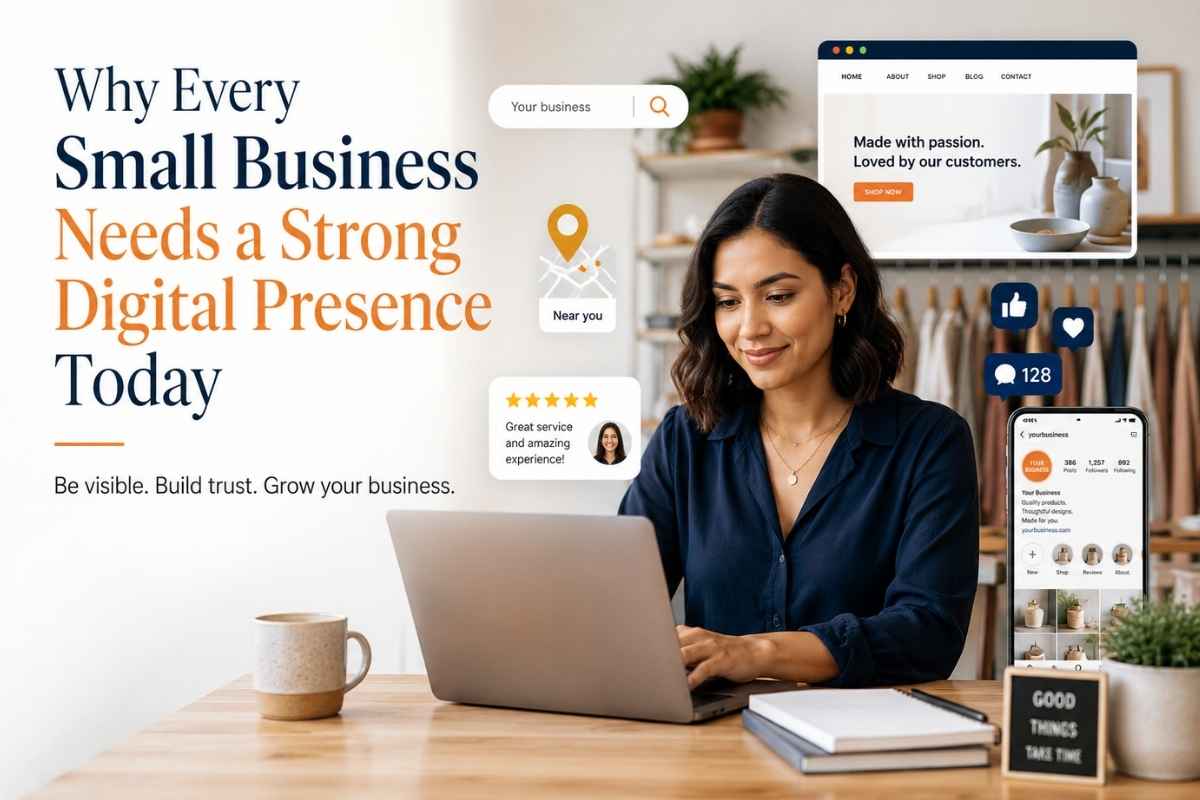
There was a time when a good location, word-of-mouth reputation, loyal customers, and a few newspaper advertisements were enough for a small business to survive and grow. A shop on a busy street, a restaurant known in the neighbourhood, a consultant recommended by friends, or a service provider trusted by local clients could continue business comfortably for years.
That world has changed.
Today, before people visit a restaurant, book a hotel, hire a professional, choose a service, buy a product, or trust a business, they usually search online first. They check Google. They look at reviews. They visit Instagram pages. They compare photos. They read comments. They see whether the business has a website, a proper address, a phone number, updated information, and a professional digital presence.
In simple words, your digital presence has become your first impression.
For small businesses, this is no longer optional. It is not only for big brands, national companies, or technology startups. Whether you run a café, salon, boutique, homestay, dental clinic, restaurant, gym, travel service, consultancy, real estate office, or local store, your online visibility directly affects how people discover, judge, and approach your business.
Customers Search Before They Trust
The modern customer is more informed, more impatient, and more selective. Earlier, people depended heavily on recommendations from family, friends, and local contacts. Today, they still value recommendations, but they verify them online.
A customer may hear about a business from someone, but before making a decision, they usually search for it. If they find updated photos, good reviews, clear contact details, and active social media pages, trust begins to build. If they find nothing, outdated information, or poor presentation, doubt begins immediately.
This is especially important for small businesses because trust is often the biggest deciding factor. A well-maintained online presence tells people that the business is active, serious, and approachable. A weak or absent online presence creates hesitation, even if the actual product or service is good.
Google Visibility Is the New Business Card
For many customers, Google is the first point of contact with a business. When someone searches for “best café near me,” “salon in Panaji,” “homestay in Goa,” “digital marketing agency,” “restaurant for family dinner,” or “interior designer near me,” they are already showing intent.
This means they are not casually scrolling. They are looking for a solution.
A small business with a properly updated Google Business Profile can gain a major advantage. Business name, address, phone number, working hours, location map, photos, customer reviews, and service details can all influence a customer’s decision within seconds.
In many cases, customers may not even visit the website first. They may call directly from Google, check directions, read reviews or look at photos. That is why local search visibility is one of the most powerful tools for small businesses today.
A Website Gives Credibility
Some small business owners feel that social media is enough. While social media is important, a website still plays a different role. A website gives a business a more permanent and professional identity.
Social media platforms are rented spaces. Their algorithms change. Their reach fluctuates. Posts disappear quickly. But a website acts as a business’s official digital home. It allows customers to understand who you are, what you offer, where you are located, how to contact you, and why they should trust you.
A simple website with basic pages such as About, Services, Products, Contact, Gallery, Testimonials, and FAQs can make a major difference. It does not have to be complicated or expensive. What matters is that it should be clear, mobile-friendly, updated and easy to navigate.
For businesses that want long-term credibility, a website is not a luxury. It is a foundation.
Social Media Builds Familiarity
While a website builds credibility, social media builds familiarity. Platforms like Instagram, Facebook, LinkedIn, YouTube, and WhatsApp help businesses stay visible in the daily lives of their audience.
For restaurants, cafés, and hotels, social media can show food, ambience, guest experiences, offers, and events. For consultants and professionals, it can share insights, client stories, achievements, and useful advice. For retailers, it can showcase products, new arrivals, customer reviews, and seasonal promotions.
The goal is not just to post randomly. The goal is to build recall.
People may not buy immediately after seeing one post. But if they keep seeing useful, attractive, and relevant content over time, the brand becomes familiar. When the need arises, the business that stays visible has a better chance of being chosen.
Reviews Influence Buying Decisions
Customer reviews have become one of the strongest forms of digital word-of-mouth. A business may claim to be excellent, but customers trust other customers more.
Positive reviews on Google, travel platforms, food platforms, social media and business directories help build confidence. They show that real people have experienced the product or service and found it worthwhile.
At the same time, negative reviews cannot be ignored. Every business faces complaints at some point. What matters is how the business responds. A polite, responsible and solution-oriented response can actually improve trust. Silence, anger or carelessness can damage reputation.
Small businesses should actively encourage happy customers to leave reviews. They should also monitor feedback regularly and respond professionally. Online reputation is now a business asset.
Content Helps Businesses Stay Visible
Content is not only for media companies or influencers. Every business needs content today.
A bakery can post behind-the-scenes videos. A doctor can share health awareness tips. A real estate consultant can explain buying procedures. A restaurant can tell the story behind a dish. A salon can educate customers about haircare. A travel company can share destination guides. A financial advisor can simplify money matters.
Good content does three things: it informs, attracts and builds trust.
Businesses that create useful content are not just selling. They are helping. This changes the relationship with the audience. Instead of appearing only when they want a sale, they become a source of knowledge, guidance and value.
Over time, this can create stronger customer loyalty.
Digital Presence is Not only for Big Brands
One of the biggest misunderstandings among small businesses is that digital presence requires a large budget. That is not true.
A small business can begin with simple steps:
Update Google Business Profile.
Create a basic website.
Post consistently on social media.
Use good-quality photos.
Collect and respond to reviews.
Share customer stories.
Keep contact details clear.
Use WhatsApp Business properly.
Create useful content.
Track enquiries and responses.
The key is consistency. A small business does not need to do everything at once. It needs to start with the basics and improve gradually.
WhatsApp, Maps, and Local Listings Matter
In India, WhatsApp plays a major role in customer communication. Many customers prefer sending a quick message instead of making a formal phone call. A properly set up WhatsApp Business account with a catalogue, greeting message, quick replies, address, and working hours can make communication smoother.
Similarly, maps and local listings are important for businesses that depend on physical visits. If customers cannot find the location easily, they may choose another option. Clear directions, updated landmarks and accurate map pins can directly affect footfall.
For tourism, hospitality, retail and local services, these small details can make a big difference.
The Future Belongs to Visible Businesses
A business may be excellent, but if people cannot find it, remember it or trust it online, it loses opportunities. In today’s market, visibility is not vanity. It is survival.
Customers are online. Competitors are online. Decisions are happening online. Reputation is being built online. Conversations are taking place online. A business that ignores this reality risks becoming invisible.
A strong digital presence does not mean shouting louder than everyone else. It means being present, useful, trustworthy and easy to reach. It means allowing customers to discover you, understand you and connect with you at the right moment.
For small businesses, the message is clear: digital presence is no longer a future requirement. It is today’s basic business infrastructure.
The businesses that understand this early will not only attract more customers but also build stronger brands for the long term.