
For years, Apple positioned itself as the company that sold premium hardware and delivered software as part of the experience. You bought the iPhone once, and the software arrived every year.
WWDC 2026 may have signaled the beginning of a different era.
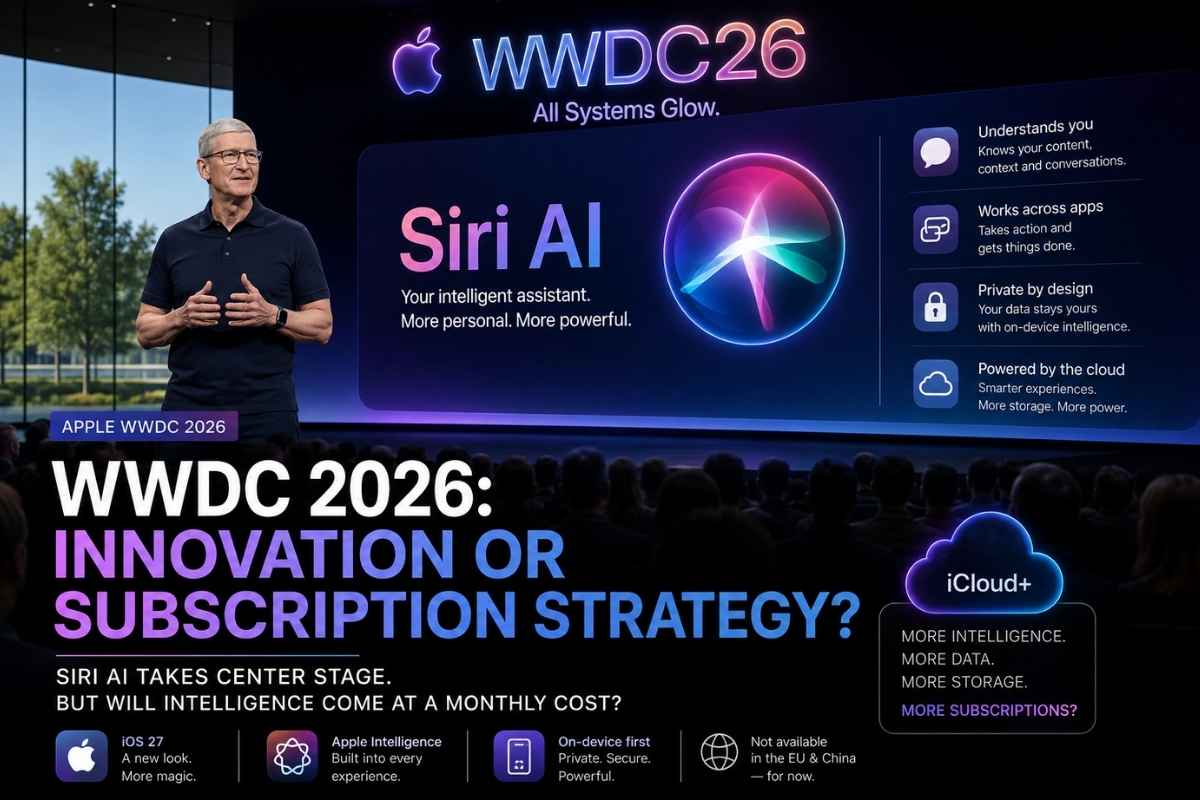
After months of anticipation, Apple unveiled iOS 27 and what it described as an entirely new generation of Siri powered by Apple Intelligence. The company showcased a much smarter assistant capable of understanding personal context, searching emails and messages, recalling information from photos, interacting across applications, and responding with a level of intelligence previously unavailable on Apple devices.
The presentation was impressive.
But it also raised an important question.
Are we witnessing the future of intelligent computing, or the beginning of a deeper subscription-driven ecosystem?
Many users expected WWDC 2026 to introduce revolutionary operating system features. Instead, the spotlight remained firmly fixed on Siri AI. In many ways, the keynote felt less like a traditional software launch and more like Apple’s attempt to catch up in the rapidly evolving race for artificial intelligence.
The irony is that many of these capabilities were expected much earlier. Apple had already generated excitement around a smarter Siri, yet users spent months waiting for features that never fully arrived. WWDC 2026 was, therefore, not only a launch event but also a moment of delivery on previous promises.
The new Siri AI is undeniably ambitious.
It can search through your emails, understand conversations, locate information hidden inside documents, recall details from photographs, and perform tasks across applications. Apple calls this “personal context.”
But personal context comes with a practical reality.
The more an AI assistant knows about you, the more information it must process, organize, synchronize, and potentially store.
That leads to a question millions of users should be asking today:
How much of this intelligence will ultimately depend on cloud infrastructure?
Apple currently offers only limited free iCloud storage. Many users already struggle with backup limitations, photo libraries, and device synchronization. If AI-powered experiences become increasingly dependent on personal data, some consumers worry that the free tier may eventually become insufficient.
Apple has not announced any requirement to purchase iCloud+ to use Siri AI.
That fact must be acknowledged.
However, business observers may reasonably wonder whether AI will become the strongest driver yet for future iCloud subscriptions.
After all, recurring subscription revenue is far more valuable than one-time hardware sales. Every technology giant is pursuing subscription-based business models because predictable recurring revenue produces long-term financial stability.
If artificial intelligence becomes deeply integrated into everyday life, cloud storage could become as essential as internet access itself.
Another interesting aspect of Apple’s announcement is geographic availability.
The company confirmed that Siri AI will not initially launch in the European Union and China. Apple cites regulatory and compliance challenges as the primary reason.
That explanation may be accurate.
But it also highlights a broader global debate.
Who controls personal data?
Where is that data stored?
How is it processed?
And who ultimately profits from it?
These questions are becoming central to the future of artificial intelligence.
For Apple users, the real discussion is not whether Siri AI is impressive. By most demonstrations, it clearly is.
The discussion is whether consumers are comfortable moving toward a future where their digital assistant understands their life in unprecedented detail and where cloud services may become increasingly important to unlocking that intelligence.
The technology is exciting.
The possibilities are enormous.
But every technological leap comes with a cost, whether financial, privacy-related, or both.
WWDC 2026 may be remembered not as the year Apple reinvented Siri, but as the year Apple began transforming artificial intelligence into the next major pillar of its services business.
The question now belongs to users:
If the future of intelligence eventually requires more cloud storage, more synchronization, and more subscriptions, are you willing to pay for it?